
How much space does a cord of firewood take up?
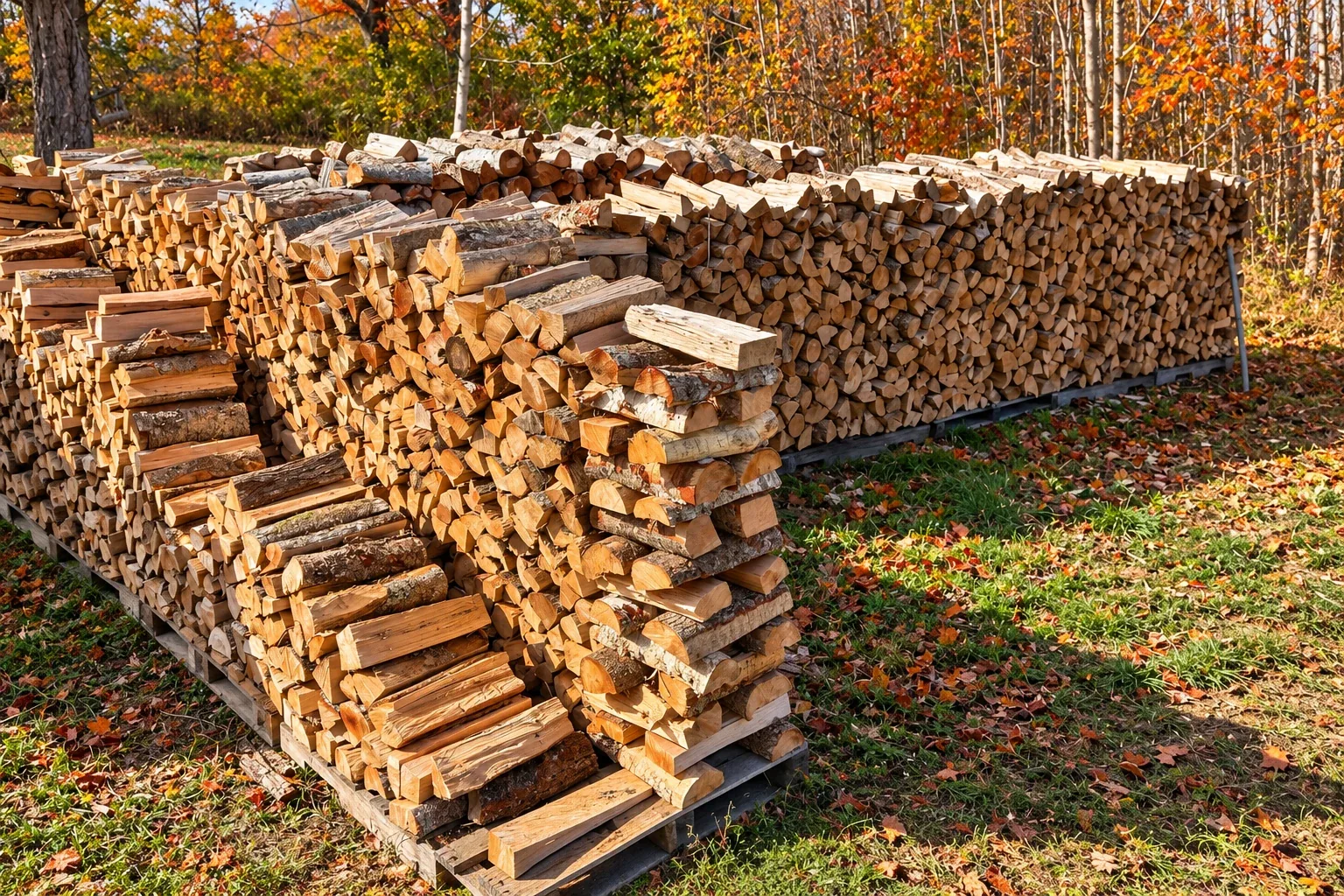
One cord is 128 cubic feet of neatly stacked firewood, including the normal spaces between pieces. A stack 8 feet long, 4 feet high and 4 feet deep is one example. A different shape can hold the same amount.
If you’re getting a delivery, the useful question is often “Where is all this going to fit?” Once it arrives, you may also want to check the quantity. This guide explains both, using Canadian measurement guidance and examples you can work through with a tape measure. It applies in the Annapolis Valley and wherever a cord means 128 stacked cubic feet.
What does a cord of firewood look like?
Measurement Canada defines a cord as 128 stacked cubic feet. Think of it as a volume, not one compulsory stack shape. The diagrams below keep height and depth at 4 feet and change the length.
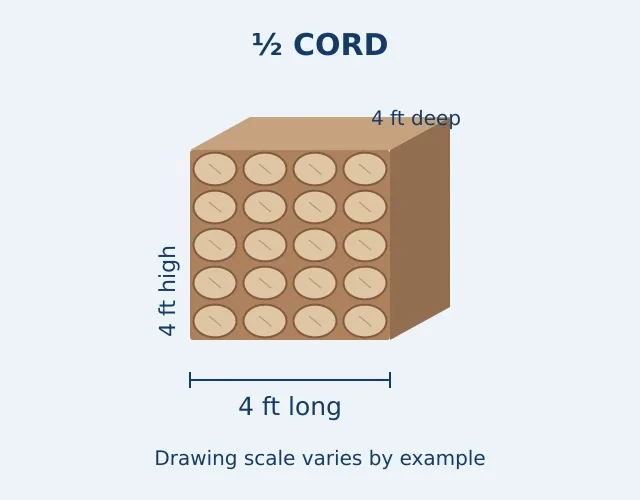
4 ft long × 4 ft high × 4 ft deep
64 cubic feet
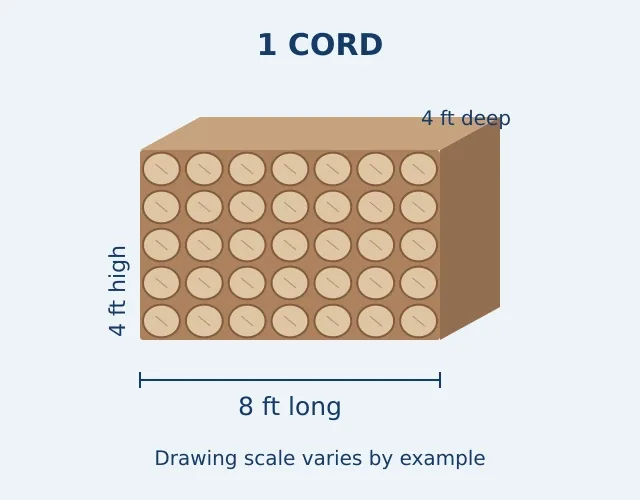
8 ft long × 4 ft high × 4 ft deep
128 cubic feet
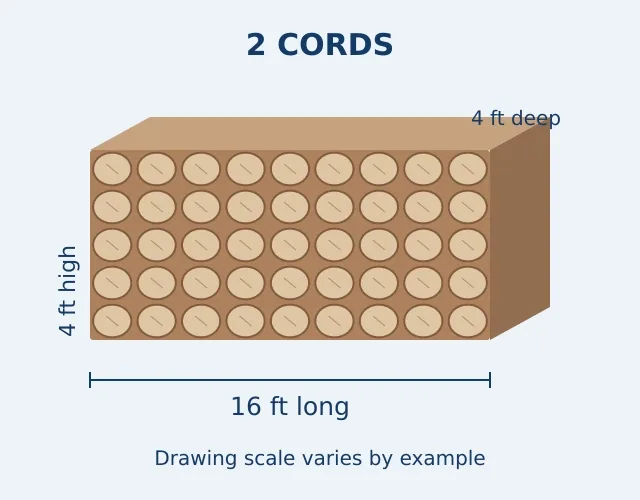
16 ft long × 4 ft high × 4 ft deep
256 cubic feet
These are measurement examples, not a recommended drying arrangement or a safe-height guarantee. The illustrations use different drawing scales. Choose a stable stack and allow for access and airflow.
How much room do 16-inch logs need?
For a single row, depth means the average log length from front to back. A row of 16-inch logs is only 1⅓ feet deep—not 4 feet deep. That changes how long your row needs to be.
| Quantity | Combined row length | One way to arrange it |
|---|---|---|
| ½ cord | 12 ft | One 12-ft row |
| 1 cord | 24 ft | Three 8-ft rows |
| 2 cords | 48 ft | Six 8-ft rows |
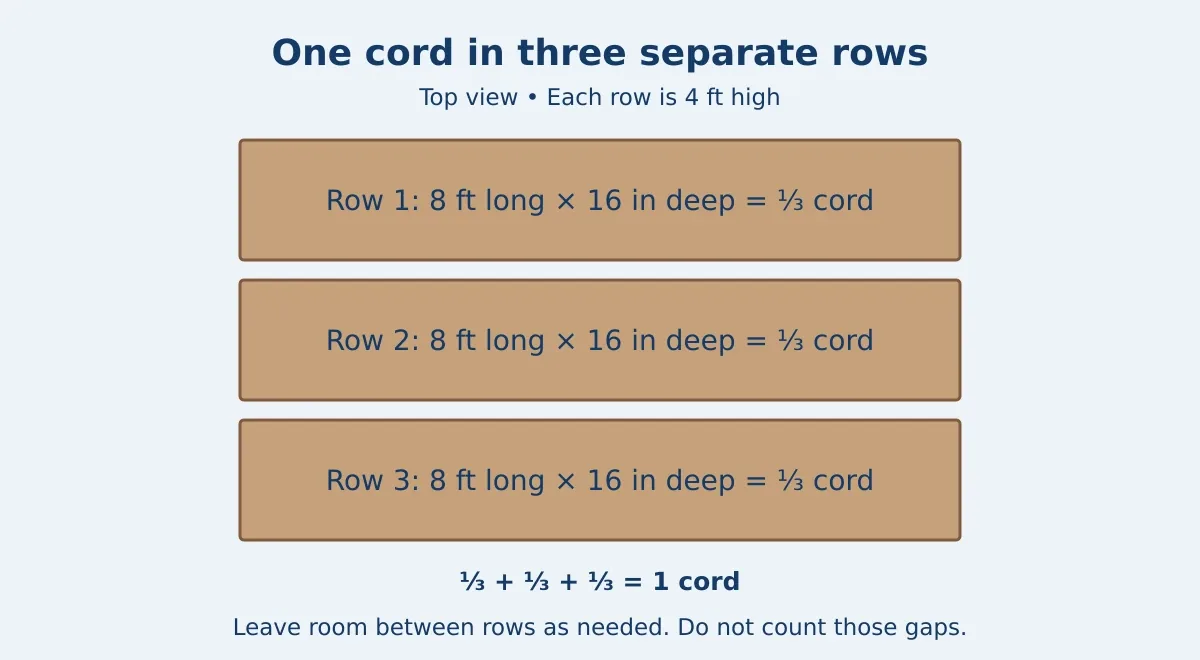
Your storage area needs more room than the wood itself. Leave space to approach the stack, move wood and keep doors and paths usable. Account for the support or rack too. These examples measure wood only; they do not include aisles or determine whether a floor, rack or shelf can carry the load.
How do you measure a stack?
- Measure the length along the face of the row.
- Measure the average height. For an uneven top, measure several evenly spaced points and average them rather than using the tallest piece.
- Measure the depth. For one row, use the average log length. Measure separate rows individually if they differ.
- Multiply length × height × depth in feet, then divide by 128.
Stacked cubic feet ÷ 128 = cords
For example: 12 ft × 4 ft × 16/12 ft = 64 cubic feet = half a cord. Convert inches to feet before multiplying. The calculator below does that conversion for you.
The Nova Scotia measuring guide recommends averaging uneven heights and log lengths. Ordinary spaces between neatly arranged pieces belong in the measurement; large empty pockets do not. A quick tape-measure estimate is useful, but it is not a formal inspection.
Firewood cord calculator
Enter the dimensions of each neatly stacked rectangular row. Add separate rows to combine them. Do not include gaps between rows, pallets or empty rack space.
An estimate of stacked volume—not weight, price, heating time, moisture content or structural capacity. Irregular stacks and measurement errors affect the result. Metric conversion uses 1 cord ≈ 3.6246 m³.
For several rows, add the volumes—not the spaces between them. For example, three 8 ft × 4 ft × 16 in rows are each about 0.333 cord. Together they make one cord. Two unequal rows measuring 12 ft × 4 ft × 16 in and 6 ft × 4 ft × 16 in total 0.75 cord.
This follows Measurement Canada’s length × height × width method, with unit conversions and row totals handled for you. A fraction of a cord is not a judgement about whether a delivery is short: compare it with the quantity and condition you actually ordered.
Is a face cord the same as a full cord?
Do not assume so. Measurement Canada does not recommend buying by descriptions such as “face cord,” “stove cord” or “apartment cord.” Its selling guidance explains that these terms can refer to quantities smaller than a full cord.
Ask for the actual stacked volume or a clearly stated fraction of a cord. An 8-ft-long, 4-ft-high row with 16-inch logs is one third of a cord. The same face dimensions with 12-inch logs hold one quarter. The word “face” alone does not tell you the depth.
Outside Canada, check the rules and terminology where you live. The arithmetic here still applies whenever the agreed unit is 128 stacked cubic feet.
Can you measure a loose pile or truckload?
A loose pile has different air spaces from a neatly arranged stack. Treating its outer dimensions as stacked wood can give a misleading result. There is no loose-pile conversion built into this calculator. Stack the wood for measurement, or agree on a clear measured quantity with the supplier.
Before ordering, confirm the quantity, log length, species or mix, condition and delivery arrangements. Keep the receipt showing quantity, type, supplier details and price. If you believe the delivery is short, Measurement Canada advises contacting the seller before using the wood and trying to resolve it with them first.
How should you stack and store the wood?
Measuring a cord and drying firewood are different jobs. For drying, Nova Scotia’s wood-storage guide recommends raised stacks, protection from rain and snow, and air circulation. Plan around those needs rather than packing every available corner.
- Use a sound, level support and suitable end supports so pieces cannot roll out.
- Keep the stack manageable; do not build it higher than the support system or conditions safely allow.
- Protect the top from rain and snow while allowing airflow around the sides.
- Keep walking routes, doorways and appliance clearances unobstructed.
Do not assume wood is ready to burn because it was stacked months ago. Drying depends on the wood and conditions. Natural Resources Canada’s residential wood-heating guide explains moisture-meter checks and describes seasoned wood at about 20% moisture. Follow your appliance and meter instructions rather than judging readiness by time alone. This guide does not assess your appliance or approve an indoor storage location.
The fuel-preparation section of Natural Resources Canada’s wood-heating guide (2002) also describes outdoor stacks off the ground with room for circulating air. We use that storage guidance here, not the older publication’s equipment prices or installation rules. Choose your layout before delivery so you can avoid carrying the same wood twice.
Need help moving and stacking firewood in the Annapolis Valley?
Valley Labour moves and stacks delivered firewood around Annapolis Royal and nearby communities. We provide the labour; this is not a firewood-sales service.
For an estimate, send the approximate quantity, photos of the pile and storage area, carrying distance and any steps or access restrictions. We’ll review the work and our availability before arranging service.
Sources and guidance (6)
- Measurement Canada: Buying firewood
- Measurement Canada: Measuring bulk firewood
- Measurement Canada: Selling firewood and units of measurement
- Nova Scotia: Buying and Measuring Stacked Firewood (PDF)
- Nova Scotia: Buying and Storing Your Winter’s Wood (PDF)
- Natural Resources Canada: A Guide to Residential Wood Heating (PDF, 2002; fuel storage section)
What would help you next?
Should you rake leaves or leave them? A Nova Scotia fall cleanup guide
Protect the lawn, leave room for wildlife and decide which fall cleanup tasks matter most at your property.
Read the guide
How often should you clean your gutters in Nova Scotia?
Build a practical spring-and-fall routine, spot drainage concerns from the ground and decide when your home needs another check.
Read the guide