
Which perennials should you cut back in fall—and which should you leave?
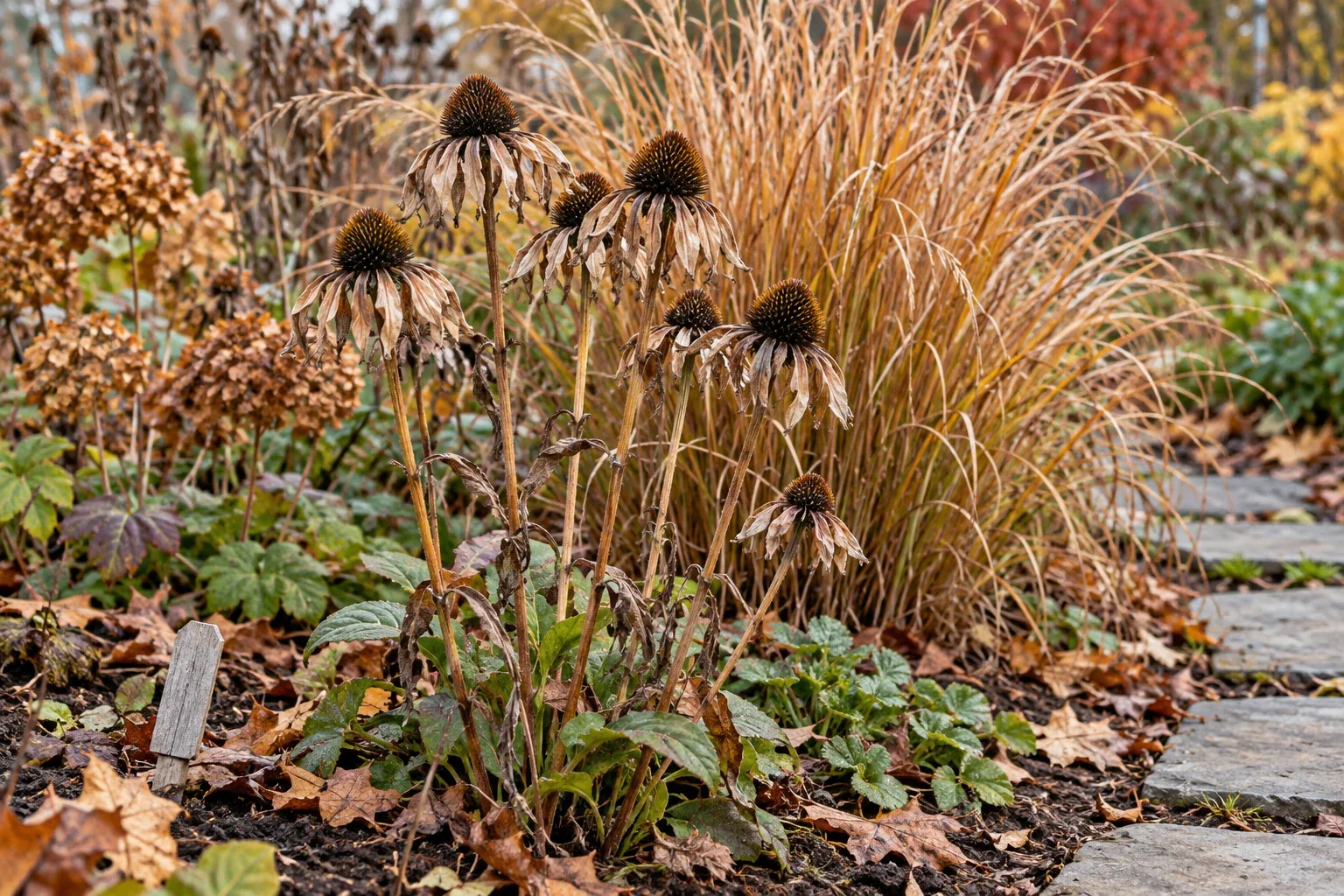
You do not need to cut every perennial down in fall. Tidy dead, collapsed foliage where needed, remove problem material, and leave suitable healthy stems and seed heads for winter. Before cutting, identify the plant and look for living leaves or buds at its base.
Jump to the plant-by-plant reference ↓ · See where to make the cut ↓
A garden can be ready for winter without being bare. For homeowners around Annapolis Royal and the Annapolis Valley, the useful question is not “Have I cut everything?” It is “What needs attention, and what is better left alone?” This guide focuses on established perennial flower beds—not shrub pruning, vegetable gardens or a complete plant-identification guide.
Quick reference: what to cut and what to leave
Find your plant below, then check its condition. These are familiar garden plants—not a ranking or a complete list. Disease or a different species can change the advice. Leaving healthy growth until spring is a valid choice.
| Plant | Fall action | Where to cut / what to protect |
|---|---|---|
| Hosta Hosta species and hybrids | Tidy after leaves yellow and collapse. | Clip dead leaf stalks just above the crown. Leave firm buds and roots intact. |
| Daylily Hemerocallis | Tidy dead leaves after natural dieback. | Snip above the crown; keep healthy green fans and any new shoots. |
| Herbaceous peony Non-woody garden peony | Cut after a hard freeze kills the foliage. | Leave about 2.5 cm (1 in) of dead stem above ground. Collect fallen foliage; protect the crown and buds. Not for tree or Itoh peonies. |
| Bearded iris Bearded Iris hybrids | Remove dying leaves and old debris. | Snip individual dead or damaged leaves above the rhizome (the thick surface stem). Keep healthy green leaves; do not slice into or bury the rhizome. |
| Siberian iris Iris sibirica and hybrids | Tidy once the foliage has died back. | Cut dead leaves above the crown without cutting into the clump. Keep green leaves until they die naturally. |
| Tall garden phlox Phlox paniculata | Cut dead stems back in late fall. | Snip near the base, above the crown or any new growth. Keep diseased material out of home compost; see disposal advice below. |
| Creeping phlox Phlox subulata and similar low mats | Keep the living leafy mat. | Remove only dead or damaged pieces as needed. Routine shaping belongs after flowering, not a low fall cutback. |
| Catmint / Nepeta Common garden Nepeta hybrids | Tidy dead tops after dieback. | Cut dead stems above the crown and any living basal leaves. A trim for repeat flowers is a separate growing-season task. |
| Astilbe Astilbe species and hybrids | Leave sound faded plumes for winter. | In spring, remove old stems and leaves near ground level, keeping the crown and emerging shoots intact. |
| Coneflower Echinacea | Leave healthy stems and seed heads. | No fall cut needed for tidiness alone. In spring, protect new basal leaves and retain some suitable stems for habitat. |
| Black-eyed Susan Rudbeckia | Leave healthy stems and seed heads. | Tidy in spring above new growth. Remove selected seed heads if you want fewer seedlings. |
| Upright stonecrop / sedum Hylotelephium | Leave firm flower heads for winter. | In spring, cut old stalks above emerging shoots. This entry is for upright types, not low evergreen stonecrops. |
| Ornamental grasses Deciduous types, such as feather reed grass | Usually leave standing through winter. | Remove dead blades above the crown in spring; keep new growth intact. Evergreen grasses and sedges need selective tidying, not the same cut. |
| Coral bells Heuchera | Keep the leafy clump. | Do not shear it down. In cold regions, leave winter-killed foliage until spring to help protect the crown. |
| Bleeding heart Lamprocapnos spectabilis; formerly Dicentra | Tidy after natural dieback. | Snip fully dead stems just above ground without disturbing the crown. Foliage may disappear well before fall; mark its spot and leave green growth alone. |
Table guidance: Calgary Horticultural Society, Garden Centres Canada, the Canadian Peony Society and the plant-specific references below.
Peony caution: tree peonies keep woody stems and must not be cut down like herbaceous peonies. Itoh/intersectional peonies also deserve type-specific instructions. If you are unsure which you have, identify it before cutting.
When should you start in Nova Scotia?
Watch the plant, not just the calendar. For ordinary end-of-season cutback, wait until that plant’s foliage has naturally died back or been killed by a hard freeze. A light frost on the lawn does not mean every plant in the bed is finished. Healthy green leaves are still doing useful work.
Use this as a garden-by-garden decision around the Valley: a sheltered bed beside a house may be at a different stage from an exposed spot. Use plant-care principles from reliable sources, then match timing to your own garden. Calgary Horticultural Society explains the benefits of selective fall cleanup; its local calendar and weather are not a Nova Scotia schedule.
- Still green and healthy? Leave the foliage for now.
- Dead and collapsed? Identify it, then tidy if appropriate.
- Firm, healthy seed heads or stems? Consider leaving them through winter.
- Unknown, evergreen or woody? Pause before making a low cut.
Work from paths or firm ground. If your boots sink and leave deep marks in a wet bed, postpone access rather than trampling the soil.
Where exactly should you make the cut?
The crown is the junction where shoots and roots meet, usually at or near the soil surface. It is the part you are protecting—not something to trim away. Brush loose leaves aside gently so you can see what you are doing.
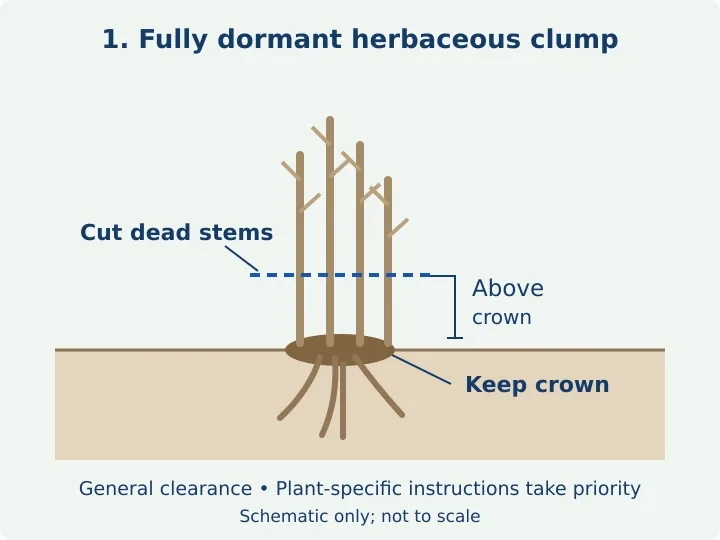
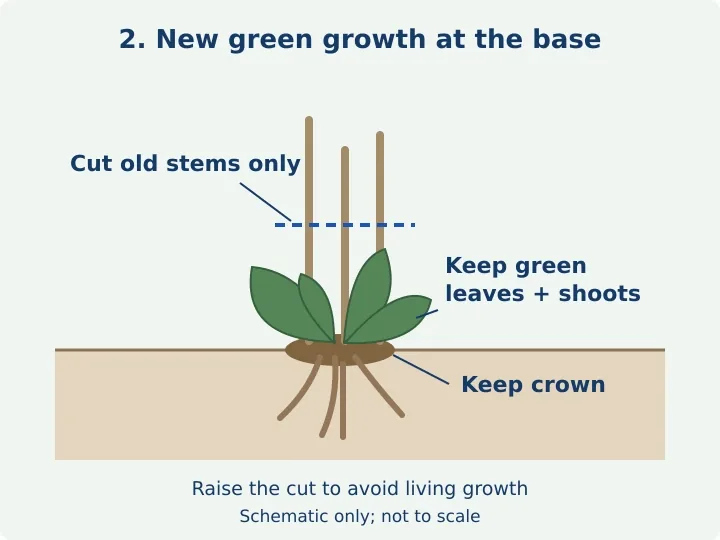
These are technique diagrams, not plant-identification pictures or a universal cutting height. RHS explains how to cut close to the crown while staying above young basal growth. Use its technique guidance with Nova Scotia conditions, rather than copying British calendar dates.
Woody or evergreen plant? Neither diagram is permission to cut it low. Lavender may not regrow from old leafless wood. Russian sage has its own spring cutback guidance, while heuchera needs selective leaf tidying.
How to cut back a plant without damaging it
- Identify and inspect. Check the label or a reliable plant record. Look for woody stems, green basal leaves and new buds.
- Choose the tool. Use sharp hand pruners or garden scissors suited to the stem. Wear gloves; keep the hand holding the foliage above and clear of the blades.
- Cut a small handful at a time. Work above the crown or living growth. Do not run hedge shears across a mixed bed at one height.
- Clip rather than tug. If old material resists, snip it. Pulling can disturb the crown or nearby shoots.
- Collect selectively. Keep suspect material separate from healthy clippings. Remove a collapsed mat without aggressively raking through crowns.
- Clean before moving on. Brush off soil and plant residue. After suspect disease, disinfect before the next plant using a suitable product according to its label.
RHS includes clean tools and disinfected pruning tools in its disease-prevention guidance. Remove residue and follow the disinfectant’s label rather than assuming a quick wipe is sufficient.
What if the plant looks diseased?
Normal autumn browning is not automatically disease. Photograph unusual spotting, mildew, rot or insect damage before cleanup, and seek a plant-specific diagnosis if uncertain. Removing affected material can reduce carryover for some problems, but it is not a cure for every disease.
For confirmed problems, collect affected foliage rather than leaving it beneath the plant. Do not assume a cool home compost pile will destroy the pathogen. Confirm an accepted disposal route with your local collection authority; invasive plants and some diseased material may need different handling. Our leaf cleanup guide links to local yard-waste guidance.
Can you keep the garden tidy and still help wildlife?
Yes. Clear paths, remove problem foliage and leave selected healthy stems standing. You can tidy the front edge while retaining seed heads and habitat farther back. Seed heads may produce seedlings, so decide where that is welcome.
Leaving selected healthy perennial stems can retain shelter through winter. Garden Centres Canada highlights hollow stems as one reason to keep some growth standing. Plan your spring tidy-up selectively too, rather than clearing every stem and leaf at once. The Nature Conservancy of Canada recommends retaining leaves and nesting spaces to support wildlife.
There is no single warm spring day that guarantees all insects have emerged. Keep some habitat in place instead of using one date or temperature as permission to remove everything.
What should you do with leaves and mulch?
Do not turn every bed into bare soil. Keep suitable leaf cover where it is useful, but ease dense wet mats off small crowns and evergreen foliage. Dalhousie’s winter-preparation guide notes that thick layers of leaves can mat.
Mulch around plants rather than piling it over crowns or living leaves; keep bearded iris rhizomes clear. Extra winter protection depends on the plant and site, especially for recent plantings. The Canadian Peony Society recommends winter mulch after the ground freezes for newly planted peonies. That is not a rule to bury every perennial under a fresh mound.
Not sure what the plant is? Leave yourself a useful record
Take a whole-plant photo, close-ups of leaves and stems, and any remaining flower or seed head. Add a label or a note on your garden plan. An app can suggest an identity, but a guess is not enough to justify a hard cut—especially on a woody plant. Leave uncertain growth until you can confirm the plant.
Woody shrubs need their own pruning decisions. This perennial-cleanup guide is not a shrub-pruning schedule.
A short fall garden checklist
- Identify plants before cutting.
- Wait for natural dieback on healthy herbaceous foliage.
- Tidy collapsed leaves and address confirmed disease problems.
- Leave selected healthy seed heads and stems.
- Protect crowns, green basal leaves and new buds.
- Keep paths clear and avoid trampling wet beds.
- Photograph and label anything you are leaving for spring.
Short on time? Prioritize safe access and problem material. Most healthy standing perennial stems do not need removing just because winter is approaching.
If you would like help, Valley Labour offers garden-bed care and spring and fall cleanups around Annapolis Royal. Share photos and tell us which areas need attention and what you would like left for winter. We will review the work, location and availability before discussing an estimate.
Sources and guidance (17)
- Dalhousie Agriculture: Preparing the garden for winter (PDF)
- Calgary Horticultural Society: Fall perennial cleanup
- Garden Centres Canada: Cutting back perennials in autumn
- Canadian Peony Society: Seasonal care for herbaceous, Itoh and tree peonies
- Nature Conservancy of Canada: Leave the leaves and retain winter habitat
- RHS (UK): Cutting back perennials and protecting new growth
- RHS (UK): Lavender care
- RHS (UK): Russian sage spring pruning
- RHS (UK): Heuchera care in cold regions
- Wallish Greenhouses (Alberta): Selective fall cutback and catmint
- RHS (UK): Border iris care and protecting exposed rhizomes
- RHS (UK): Siberian iris autumn foliage care
- RHS (UK): Tall garden phlox cutback
- RHS (UK): Low-growing phlox care
- RHS (UK): Astilbe winter interest and spring cleanup
- RHS (UK): Bleeding heart dieback and tidying
- RHS (UK): Preventing pest and disease problems
What would help you next?
Should you rake leaves or leave them? A Nova Scotia fall cleanup guide
Protect the lawn, leave room for wildlife and decide which fall cleanup tasks matter most at your property.
Read the guide
How to keep deer out of your garden in Nova Scotia: what actually helps
Compare barriers, repellents and less-palatable plants, with realistic steps for protecting the garden you enjoy.
Read the guide